Discover why owning multiple insurance policies does not always provide complete cyber protection and how a cyber recovery map can expose overlaps and gaps.
Consider a ransomware attack that shuts down operations, exposes customer data and results in stolen funds.
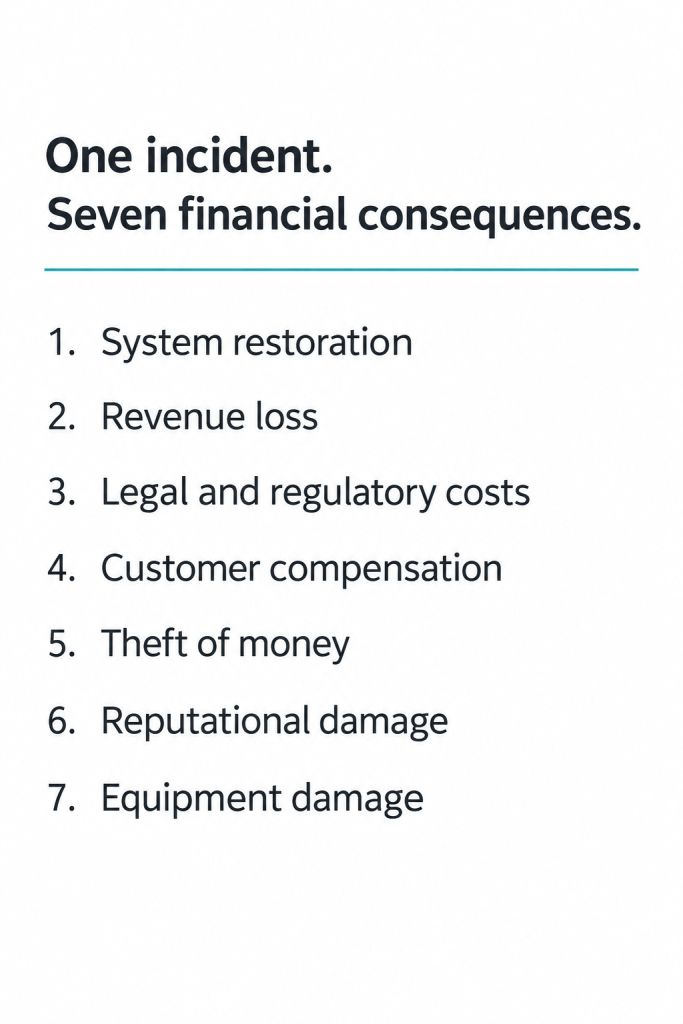
These losses may sit across cyber, business interruption, crime, privacy liability and property insurance. At first, having several relevant policies may look reassuring. However, overlapping cover does not necessarily result in multiple payouts. One policy may respond before another. Both may cover only part of the loss, or each insurer may consider the loss to fall under a different policy. This is how an organisation can pay for overlapping insurance and still face a significant funding gap after a cyber incident.
The fundamental question is therefore not:
“How many insurance policies do we have?”
It is:
“If a cyber incident happened tomorrow, which policy would pay for each financial consequence?”
One incident does not mean one insurance claim
Insurance policies respond to specific events, losses and liabilities. They do not respond simply because something has been described as a cyber incident.
The Association of British Insurers explains that cyber insurance can cover direct financial losses suffered by a business as well as liabilities to other parties. Depending on the policy, this could include damage to digital assets, data related losses and theft of funds. Association of British Insurers
However, the different consequences of an incident may still need to be considered under separate policies.
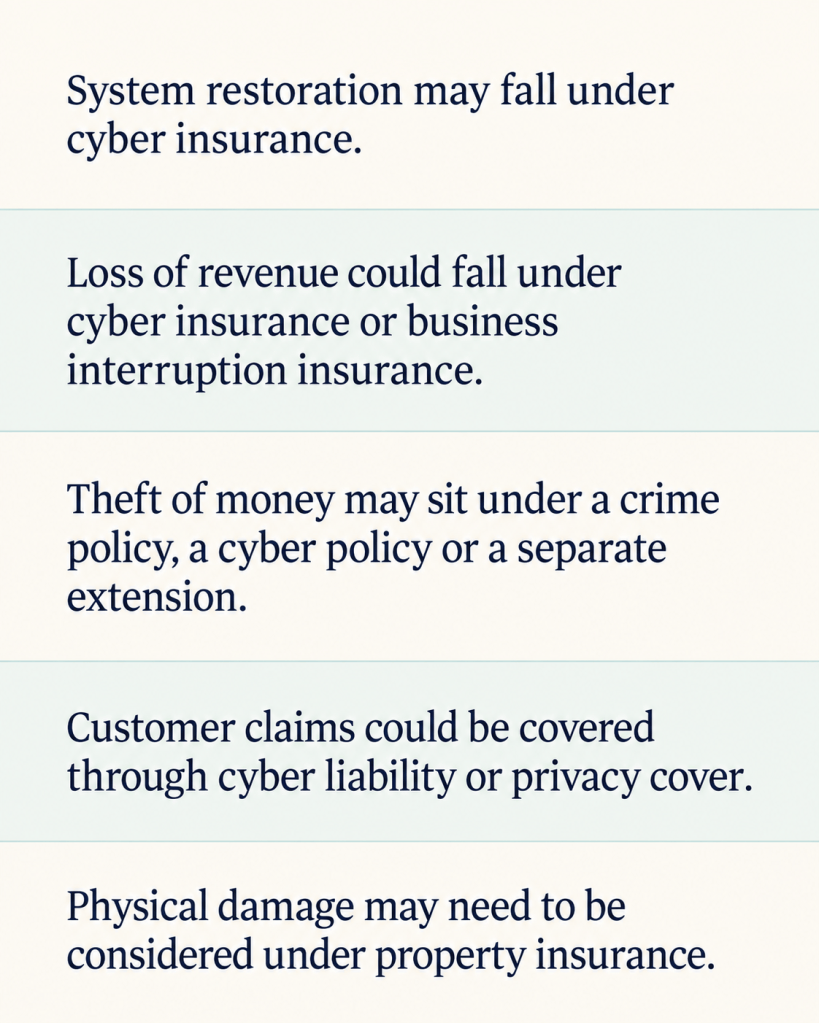
The challenge is not simply identifying policies that appear relevant. It is understanding whether those policies would actually respond to the circumstances of the incident.
Why overlapping cover does not guarantee recovery
Different policies may require different triggers
Loss of revenue is a good example.
Traditional property business interruption cover commonly requires insured physical damage before it responds. A network outage without physical damage may therefore fall outside the policy unless it contains a specific cyber extension or cover for interruption without physical damage. A cyber policy may include network business interruption, but it may have its own requirements. The disruption could need to continue beyond a defined waiting period or result from a covered security failure. If the interruption originates from a cloud provider or another technology supplier, separate dependent business interruption cover may be required.
Two policies can therefore appear relevant while the loss satisfies the trigger of only one, or neither.
The same terms may have different meanings
Terms such as computer system, security failure, privacy event, interruption, dependent business and physical damage may be defined differently across policies.
A cloud platform might be treated as part of the insured computer system under one policy but as an external service provider under another. A fraudulent payment may be treated as social engineering under a crime policy but may not satisfy the cyber policy’s definition of theft. Coverage cannot therefore be understood by looking at policy titles alone. The definitions must be tested against realistic scenarios.
The same loss cannot normally be recovered twice
Policies may contain provisions explaining how they interact with other available insurance.
One policy may respond first. Another may operate only after the first policy has been exhausted. Alternatively, two insurers may contribute proportionately to the same loss. Insurance is intended to compensate an insured loss rather than allow the same loss to be recovered several times. An organisation can therefore pay premiums for overlapping cover without increasing the amount it can recover for a particular event.
Headline limits may conceal smaller sublimits
A cyber policy may display a substantial overall limit but apply smaller sub-limits to individual categories of loss. Funds transfer fraud, social engineering, regulatory costs, dependent business interruption and data restoration may all have separate limits.
An organisation might have £10 million of total cyber cover but access only a small proportion of that amount for a fraudulent transfer. Excesses, waiting periods and maximum periods of indemnity can reduce the effective recovery further. The most relevant number is therefore not the total policy limit. It is the amount that could realistically be recovered for the particular scenario.
Exclusions can create gaps between policies
Property policies may exclude cyber related losses, while cyber policies may exclude physical damage.
Organisations should confirm whether cyber caused physical damage is affirmatively covered. This means the policy wording clearly grants the cover rather than relying on an assumption that the loss is not excluded. State backed cyber activity creates another difficult area. The Lloyd’s Market Association publishes different model cyber war clauses covering state backed attacks, war and significant impairment of a state. This demonstrates why broad assumptions about such events can be dangerous. The exact clause must be reviewed. Lloyd’s Market Association
Building a cyber recovery map
A cyber recovery map connects each financial consequence to the policy that may respond and the conditions that need to be verified.
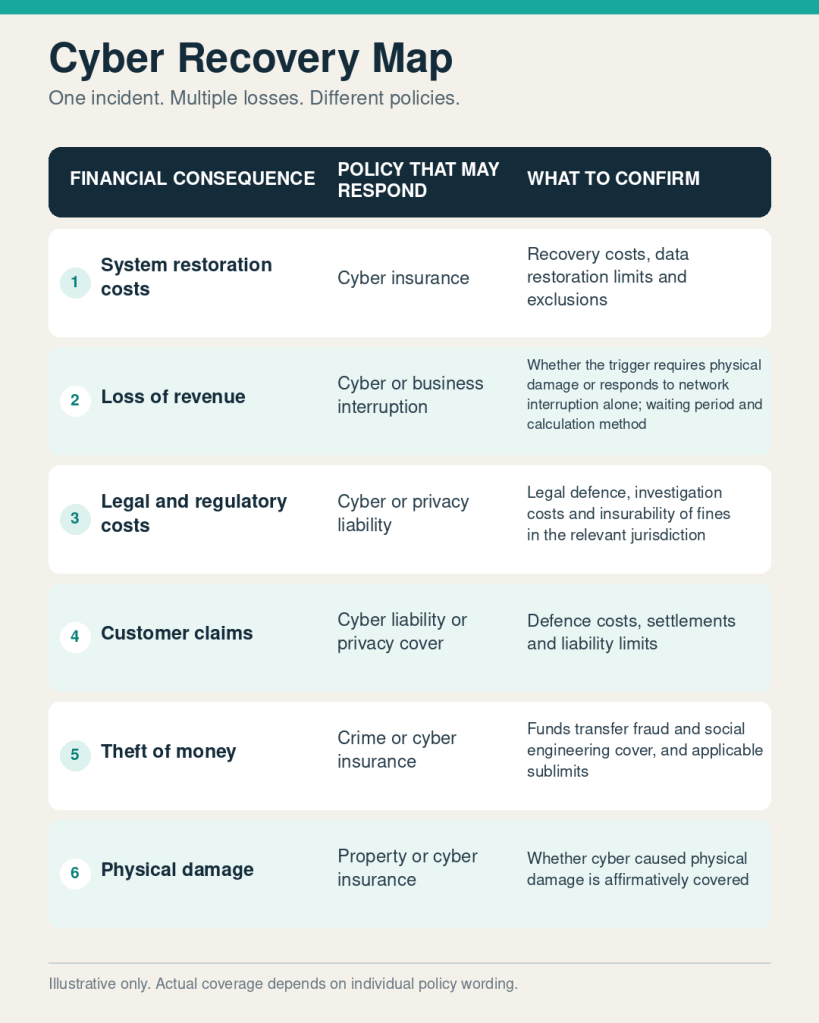
For each consequence, the organisation should identify:
- The policy expected to respond
- The applicable trigger
- The amount that could realistically be recovered
- Relevant limits, sublimits and waiting periods
- Any overlap with another policy
- The remaining loss the organisation would need to fund
The purpose of the map is not to predict whether an insurer will accept a claim. It is to identify uncertainty while the organisation still has time to resolve it.
Start with scenarios, not policies
A policy review often begins with individual insurance documents. A better approach is to begin with realistic incidents. The organisation could select scenarios involving ransomware, data theft, fraudulent payments, cloud service disruption, supplier compromise and physical damage caused by technology. Each scenario should then be divided into its financial consequences.
For example, a cloud provider outage could generate lost revenue, additional operating costs, customer compensation and regulatory expenses. Each consequence should be mapped separately because different policies, limits and conditions may apply. This moves the conversation away from the number of policies purchased and towards the protection available against actual business risks.
The real measure of cyber protection
Cyber insurance can provide important financial support following an incident. However, the value of an insurance programme cannot be measured by adding together the limits shown on different policy schedules. A business can own several policies and still discover that a material loss falls between them. The true measure of protection is the amount the organisation can realistically recover for the incidents it is most likely to face. That can only be understood by connecting realistic cyber scenarios, their financial consequences and the policies expected to respond.
Remember: Do not simply count policies. Build a cyber recovery map.
References
- Gartner, An Executive Leader’s Guide to Cybersecurity Insurance, 19 January 2026, ID G00842705.
- UK National Cyber Security Centre, Cyber insurance guidance
- Association of British Insurers, Cyber insurance
- Lloyd’s Market Association, Cyber war clauses






Leave a Reply